Certified, Licensed, and Locked Out: The Ottoman Guild Playbook That Modern Industries Still Run
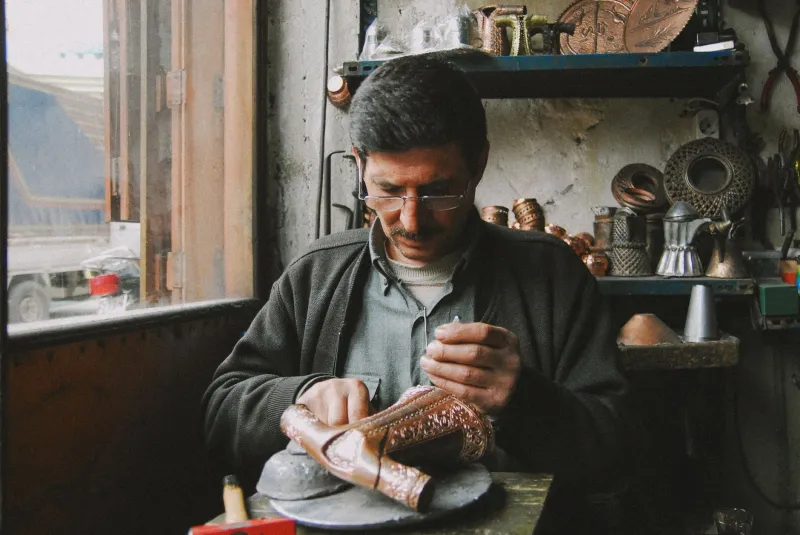
If you wanted to work as a professional craftsman in Ottoman Istanbul, you needed credentials. Not just skill — credentials. A formal certification issued by the guild, attesting to your mastery of the relevant techniques, your good standing in the community, your completion of the required training period under an approved master. The system was documented, official, and taken seriously by the imperial authorities who ultimately backed it.
It was also, from a certain angle, one of the most effective economic moats ever constructed.
How the Ottoman Guild System Actually Worked
The Ottoman guild structure, known as the esnaf, covered virtually every skilled trade in the empire's major cities. Bakers, jewelers, tanners, textile workers, physicians, architects — each profession had its own guild, its own hierarchy, its own certification requirements. The system had genuine benefits. It standardized quality, resolved disputes, provided mutual aid to members, and gave the imperial government a reliable administrative interface with the commercial classes.
But the certification requirements had a feature that became increasingly prominent over time: they were expensive to complete, and the cost fell almost entirely on the applicant.
The training period under a master craftsman — the çırak and kalfa stages before achieving usta (master) status — could span a decade or more. During that time, the apprentice was dependent on their master's goodwill, working for subsistence wages or none at all, unable to practice independently or take outside work. Advancement required not just demonstrated skill but the formal approval of established masters who had every economic incentive to slow-walk the process. Guild fees, ceremonial requirements, and the cost of maintaining yourself through years of dependent training added up to a barrier that was, in practical terms, a wealth filter.
The people who made it through were disproportionately the sons and daughters of people who were already in the guild, or who had family resources to sustain a decade of near-unpaid training. The people who didn't make it through were disproportionately talented individuals without those advantages. Over generations, the guild became less a meritocracy of skill and more a hereditary professional class wearing the costume of a meritocracy.
The Quality Control Story and the Incumbent Protection Story
Here's where it gets uncomfortable for modern readers: the Ottoman guilds weren't lying when they said their certification requirements were about quality. They were, genuinely, also about quality. The training was real. The skills being tested were real. A certified usta really did know more about their craft than someone who'd picked it up informally.
But quality control and incumbent protection aren't mutually exclusive. They can operate simultaneously through the same mechanism. A certification system can be genuinely rigorous and be structured in ways that make it disproportionately accessible to people who are already economically comfortable — and the people who benefit most from the second feature will always be the most motivated to defend the first.
This is the analytical problem that makes credentialing debates so difficult. Critics who point to the barriers get accused of wanting to lower standards. Defenders who point to the standards get to avoid discussing the barriers. Both sides are, in a narrow sense, correct. The historical record suggests the relevant question isn't "are the standards real?" but "are the barriers to meeting those standards necessary to achieve the quality goals, or are they larger than the quality goals require?"
The Ottoman evidence suggests the barriers grew well beyond what quality alone required — particularly as guilds matured and the people already inside accumulated more influence over the certification process.
American Licensing in the Same Frame
The United States licenses somewhere between 20 and 25 percent of its workforce, depending on how you count. That number was around 5 percent in the 1950s. The expansion has happened profession by profession, state by state, often driven by existing practitioners lobbying state legislatures for licensing requirements in their field.
The Institute for Justice, which has tracked this extensively, has documented cases that are difficult to read without thinking of Ottoman guild masters. Louisiana requires florists to pass a licensing exam — one with a failure rate that would be notable for a medical board. Many states require hundreds of hours of training to become an interior designer, a cosmetologist, or an auctioneer. The training hours required to become a licensed cosmetologist in some states exceed the hours required to become an emergency medical technician.
None of this is happening through malice. It's happening through the same mechanism that operated in Istanbul five hundred years ago: established practitioners, through their professional associations, advise legislatures on what standards are necessary for consumer protection. Those practitioners have genuine expertise about their field. They also have a financial interest in limiting competition. The advice they give tends to reflect both things at once, and legislatures, lacking independent expertise, tend to defer to the people in the room.
The result is a patchwork of requirements that vary dramatically by state for the same profession, that frequently don't transfer across state lines, and that fall most heavily on people who can't afford to spend a year in unpaid or low-paid training to meet them.
Who Gets Frozen Out
The demographics of credentialing barriers are not random. Research consistently shows that licensing requirements reduce employment in affected occupations, reduce geographic mobility among workers in those occupations, and reduce the representation of lower-income workers and workers of color relative to what their skill distribution would predict. This is exactly the pattern the Ottoman guild system produced over centuries of operation: a professional class that was more economically homogeneous than the population it served, sustained by requirements that were genuinely demanding but also genuinely more accessible to people who were already comfortable.
The workers who get frozen out aren't, in most cases, unskilled. They're skilled people who lack the resources to navigate a credentialing process that was designed, consciously or not, by the people it benefits.
The Defense That Always Gets Made
At this point in the argument, someone always raises the consumer protection case. Don't we want licensed professionals? Isn't it good that your surgeon has credentials?
Yes, obviously. But the surgeon example is doing a lot of rhetorical work that it shouldn't be allowed to do unchallenged. The case for rigorous licensing of surgeons doesn't automatically extend to hair braiders, which more than a dozen states have at various times required to be licensed. The skills involved are different, the risks are different, and the appropriate level of regulatory burden is different. Treating all professional licensing as equivalent to medical licensing is exactly the conflation that incumbent practitioners rely on when they're defending their barriers.
The Ottoman guild masters also made the quality control argument. They made it in good faith, mostly. And the argument was true, as far as it went.
It just didn't go far enough to explain why the training period kept getting longer, why the fees kept going up, and why the sons of guild masters kept passing at higher rates than anyone else.
What the Historical Pattern Suggests
Credentialing systems start as quality mechanisms and evolve, almost inevitably, toward incumbent protection — not because the people running them are villains, but because the people with the most influence over the system are the people already inside it, and they have interests that don't perfectly align with the interests of consumers or aspiring entrants.
The Ottoman guilds weren't uniquely corrupt. They were normal institutions doing what normal institutions do when the people who benefit from a policy are also the people who administer it.
Five thousand years of data doesn't offer many examples of that dynamic resolving in favor of the people on the outside.