When the Whole System Snapped: The Bronze Age Collapse as Supply Chain Autopsy
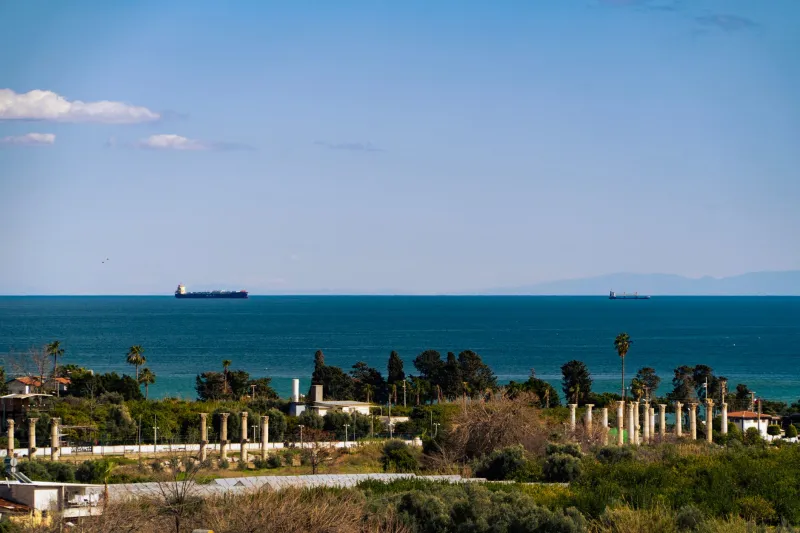
In the spring of 2021, a container ship called the Ever Given spent six days wedged sideways in the Suez Canal. Twelve percent of global trade stopped moving. Toilet paper disappeared from shelves in Ohio. Semiconductor shortages idled auto plants in Michigan. The whole thing resolved, the ship moved, and most people filed it under "weird pandemic thing" and moved on.
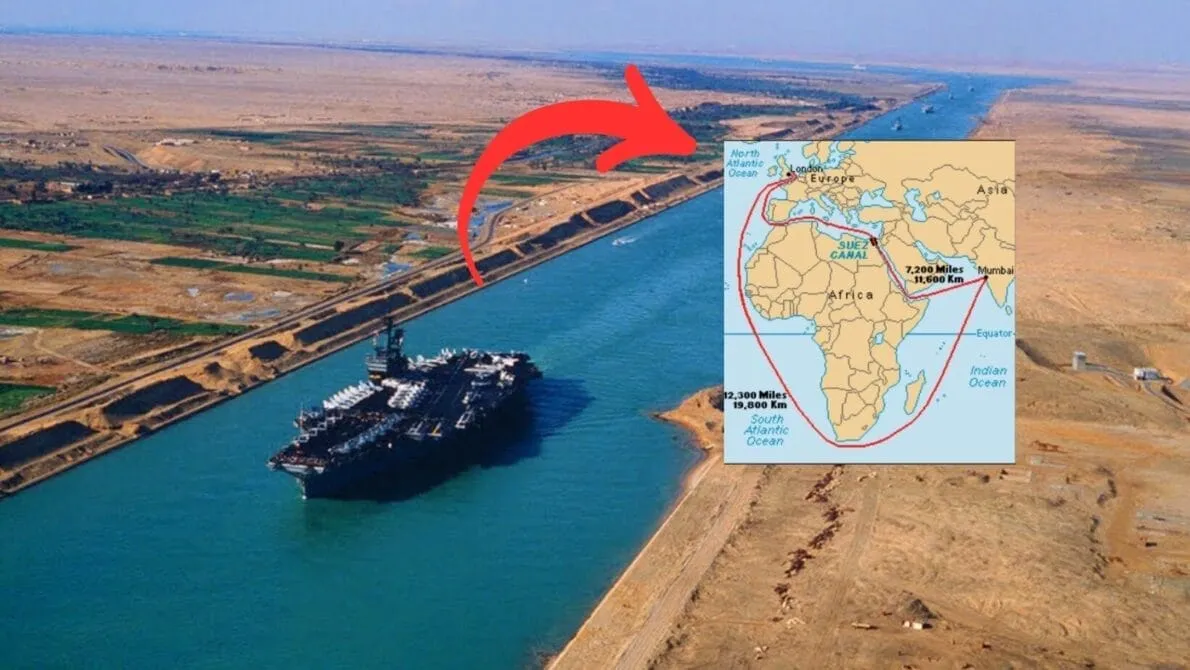 Photo: Suez Canal, via clickpetroleoegas.com.br
They shouldn't have. What the Ever Given revealed — briefly, recoverable — was the same structural flaw that brought down an entire interconnected world roughly 3,200 years ago. The Bronze Age Collapse is the most dramatic supply chain failure in recorded history, and its mechanics are almost insultingly familiar.
What the Bronze Age Actually Built
By 1200 BC, the Eastern Mediterranean was running what might be the first genuine globalized economy. Egypt, the Hittites, Mycenaean Greece, Cyprus, Ugarit, Canaan — these weren't isolated kingdoms trading occasionally at arm's length. They were deeply integrated. Egyptian grain fed populations that couldn't grow enough locally. Cypriot copper was the critical input for the bronze that made weapons, tools, and armor across the entire region. Tin — without which you can't make bronze at all — came from sources so distant that scholars still debate exactly where: Afghanistan, maybe Britain, possibly Anatolia.
The palace economies that managed all of this were sophisticated. Linear B tablets from Mycenae record inventories, ration distributions, and trade obligations in detail that looks, to a modern reader, like warehouse management software printed on clay. These were not primitive operations. They were complex, specialized, and deeply dependent on everything continuing to function.
That last part is the problem.
Single Points of Failure, Everywhere
Bronze requires copper and tin in roughly a nine-to-one ratio. Copper was available in several places. Tin was not. This meant that every civilization in the network depended on a supply chain for one critical input that ran thousands of miles through territory they didn't control. If the tin stopped moving, the bronze stopped. If the bronze stopped, the weapons stopped. If the weapons stopped, the armies that protected the trade routes stopped. You can see where this goes.
Modern supply chain managers call this a single point of failure. The Bronze Age world was full of them, layered on top of each other, connected by sea routes that required safe passage through multiple jurisdictions.
Now add drought.
Paleoclimatological research — pollen records, isotope analysis, sediment cores — has established fairly convincingly that the Eastern Mediterranean experienced a prolonged drought beginning around 1200 BC. Not a single bad year. A sustained multi-decade reduction in rainfall that hit agricultural yields across the entire region simultaneously. The grain surpluses that Egypt and other breadbasket areas had been exporting to keep the network fed started shrinking. Populations that had grown to depend on imported food couldn't pivot fast enough.
The Cascade
What happened next is what supply chain professionals call a cascade failure — and what the rest of us call a catastrophe.
Ugarit, one of the great trading cities of the ancient world, burned around 1185 BC. Archaeologists found a letter in the kiln, never sent, from the king of Ugarit to the king of Cyprus. It reads: the enemy ships are here, they have set fire to my cities and have done very great damage. It is urgent. This was not one attack on one city. The same disruption was hitting multiple nodes in the network at roughly the same time.
The Mycenaean palace centers collapsed. The Hittite Empire — which had been one of the dominant military powers in the region for centuries — disintegrated. Cyprus saw widespread destruction. Egypt survived, but barely, and emerged so weakened that it never again projected power the way it had. The entire interconnected system went from functioning to gone within a single human lifetime.
The conventional explanation used to be the Sea Peoples — mysterious raiders who showed up in Egyptian records as the cause of all this destruction. Current scholarship is more nuanced. The Sea Peoples were real, and they were disruptive. But they were probably as much a symptom as a cause: populations displaced by the same droughts and disruptions, moving and raiding because their own food systems had failed. Blaming the Sea Peoples for the Bronze Age Collapse is a little like blaming the looters for a city's collapse during a hurricane. They made things worse. They didn't cause the hurricane.
The 2020 Version
In early 2020, a virus shut down manufacturing in China. This was, in isolation, a localized disruption — the kind of thing that complex systems are supposed to absorb. What it revealed instead was that decades of just-in-time manufacturing and global supply chain optimization had created something with almost no redundancy.
Personal protective equipment was manufactured almost entirely in a handful of countries. Pharmaceutical active ingredients were sourced from a small number of suppliers, most of them overseas. Semiconductor production was concentrated in Taiwan and South Korea. The logic that created this concentration was economically rational at every individual step: it's cheaper to make things where labor and materials are cheapest, and you don't need to hold inventory if your logistics are reliable enough.
But "reliable enough" assumes the system doesn't experience shocks it wasn't designed to absorb. The Bronze Age palace economies made the same bet. Tin from thousands of miles away is fine — until it isn't. Grain imports from Egypt are fine — until the drought hits Egypt too.
Complexity Is the Risk
Here's the part that nobody in charge ever wants to hear: the more optimized a supply chain becomes, the more fragile it gets. Efficiency and resilience are in direct tension. Every redundancy you eliminate to save money is a buffer you've removed from the system. Every single-source supplier you rely on because they're cheapest is a single point of failure you've introduced.
The Bronze Age Collapse didn't happen because Bronze Age administrators were stupid. It happened because they built an extraordinarily sophisticated system that worked brilliantly right up until the moment multiple stresses hit simultaneously — which is exactly when you most need the redundancy you optimized away.
The US has spent thirty years building supply chains that look, from a structural standpoint, uncomfortably similar. Concentrated production, long geographic distances, minimal inventory buffers, deep interdependence between nodes. The system works fine in normal conditions. Bronze Age trade worked fine in normal conditions too.
The historical record on this is a dataset, not a metaphor. The same architectural choices produce the same vulnerabilities. The shocks change. The collapse mechanics don't.