Hammurabi's Separation Agreement: Why the First Employment Contract Was Actually a Divorce Document

Photo: Daderot, CC0, via Wikimedia Commons
Hammurabi's Separation Agreement: Why the First Employment Contract Was Actually a Divorce Document
Before there were employment lawyers, there were marriage lawyers. And before there were marriage lawyers, there was Hammurabi.
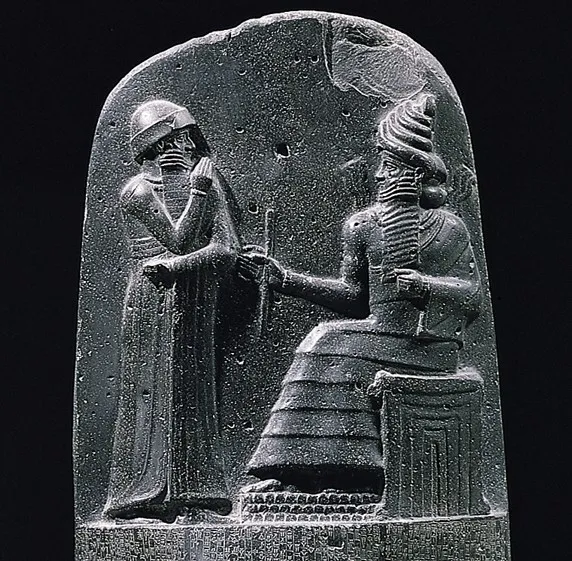 Photo: Hammurabi, via www.scientiapress.com
Around 1750 BC, the Babylonian king whose legal code you probably half-remember from a high school history class did something that doesn't get nearly enough credit in business circles: he formalized, in writing, what happens when a relationship ends. Not a business relationship. A marriage. But here's the thing — the legal logic is identical, the psychological need is identical, and the document structure is so similar to a modern severance agreement that it's genuinely unsettling.
We tend to think of employment law and family law as completely separate domains. The Babylonians, practically speaking, didn't. And they may have been onto something.
The Original Exit Clause
Under Hammurabi's code and the broader tradition of Babylonian marriage contracts — hundreds of which survive on clay tablets — a marriage wasn't just a social arrangement. It was a binding commercial agreement with detailed terms governing what happened at dissolution.
A standard contract specified what assets each party brought into the marriage, how those assets would be divided if the marriage ended, what financial obligations the wealthier party had to the less wealthy one upon separation, and who was responsible for children's support and upbringing. Depending on the circumstances of the dissolution — who initiated it, whether infidelity was involved, whether there were children — the specific terms varied, but the framework was consistent.
Some contracts included a specific clause that functioned almost exactly like a modern severance payment. If a husband chose to divorce a wife who had done nothing wrong, he owed her a set amount — often equivalent to a year or more of household expenses — as a condition of the separation being legally recognized. No payment, no clean break. The community wouldn't treat him as free to remarry until he'd settled his obligations.
If that sounds familiar, it should. Replace "husband" with "employer" and "wife" with "employee" and you have a description of a standard separation agreement in any mid-sized American company today.
Why People Need the Exit Clause in Writing
Here's what's really interesting, and it's the thing that connects ancient Babylon to the HR department in your office building.
The Babylonians weren't writing these contracts because they expected marriages to fail. They were writing them because they understood something fundamental about human psychology: people behave differently when the terms of ending something are clear before it begins.
When you don't know what leaving costs, you have two problems. The more powerful party can make exit arbitrarily expensive for the less powerful one, creating a coercive dynamic. And the less powerful party, not knowing what they're entitled to, can't make rational decisions about whether to stay or go. The written contract solved both problems simultaneously. It constrained the powerful party and informed the vulnerable one.
This is exactly why modern employment attorneys push for written severance terms at the start of senior executive relationships rather than negotiating them at the moment of departure. At the moment of departure, emotions are high, incentives are misaligned, and the power dynamic is at its most lopsided. The time to negotiate exit terms is when everyone is happy and the relationship is beginning.
Hammurabi figured this out. We keep relearning it.
The Custody Clause as Non-Compete
One detail in Babylonian divorce contracts deserves special attention for the business-minded reader: child custody arrangements.
In many Babylonian contracts, custody terms were written not just to protect the children but to govern who retained access to the household's productive resources. Children, in an agricultural economy, were labor. Custody over children was, in part, custody over future earning capacity. The parent who retained the children retained a significant economic asset.
This maps uncomfortably well onto the non-compete and non-solicitation clauses that accompany most modern executive severance packages. When a senior employee leaves a company, the employer's core concern isn't abstract — it's about who that person takes with them. Clients, colleagues, institutional knowledge, relationships. The non-solicitation clause is the modern equivalent of the Babylonian custody arrangement: a formal negotiation over who gets to keep the productive relationships.
The psychological need being addressed is identical across four thousand years. When a relationship ends, both parties immediately start calculating what they're losing and how to protect it. The law exists to channel that calculation into something enforceable rather than something ugly.
What Changed, What Didn't
Obviously, Babylonian marriage contracts operated within a social context that modern Americans would find unrecognizable in many ways. Women's legal standing was limited and inconsistent. The contracts themselves were often negotiated between families rather than between the parties to the marriage. The concept of mutual consent as the foundation of the relationship was much weaker than anything we'd accept today.
But strip away the cultural specifics, and the underlying legal architecture is strikingly intact. Written terms. Asset division formulas. Mandatory payments upon dissolution. Provisions governing dependents. Conditions that vary based on who initiated the ending and why.
The American severance agreement didn't emerge from nothing. It has a genealogy — through Roman contract law, through medieval ecclesiastical divorce proceedings, through English common law's treatment of marriage as a property relationship — that runs in a remarkably straight line back to those clay tablets in Mesopotamia.
The Lesson That Keeps Not Getting Learned
The most consistent finding across five thousand years of human negotiation is that people are bad at planning for failure when they're optimistic about success. The Babylonians institutionalized the solution: make exit planning mandatory, make it happen before the relationship begins, and make the terms public enough that community enforcement is possible.
Modern companies do this inconsistently at best. Severance terms for rank-and-file employees are often vague until the moment they become relevant, at which point the company holds most of the cards and the employee is in no position to negotiate. The result is expensive litigation, bad press, and settlements that cost more than a well-drafted agreement at the start would have.
Hammurabi's lawyers — and yes, there were lawyers, they were called scribes — would find this baffling. You had the person in front of you, you had goodwill on both sides, and you chose not to write down what happens when it ends?
Some mistakes are just timeless.