Free Money for Everyone: What Happened When Ancient Athens Tried Universal Basic Income

The World's First Cash Transfer Program
If you think universal basic income is a radical new idea, you're off by about 2,500 years. Ancient Athens beat Yang Gang to the punch by implementing the world's first functioning cash transfer program in the 5th century BC. They called it the theoric fund, and for a while, it was exactly what UBI advocates dream about: free money for everyone, funded by government surpluses, with no strings attached.
Then it fell apart. Spectacularly.
The reasons why tell us everything we need to know about the political psychology of giving people free money—and why the arguments playing out in Congress today would sound familiar to any Athenian who lived through the program's rise and fall.
Silver Mines and Surplus Cash
Athens stumbled into UBI the same way most governments stumble into good policy: by accident. In the 480s BC, Athenian slaves working the silver mines at Laurium struck an incredibly rich vein of ore. Suddenly, the city-state was swimming in cash.
The question was what to do with it. The Athenian assembly—the world's first democracy in action—had several options. They could build more ships for the navy. They could construct public buildings. They could save it for emergencies.
Or they could just give it directly to the people.
Guess which option won.
The theoric fund started as a way to distribute silver mine revenues to Athenian citizens. Every eligible adult male got an equal share, paid out regularly, no questions asked. It was literally free money from the government, funded by what we'd now call natural resource revenues.
Sound familiar? Alaska has been doing essentially the same thing with oil money since 1982.
How It Actually Worked
The Athenian system was surprisingly sophisticated. The theoric fund wasn't just a one-time windfall distribution—it became a permanent feature of Athenian public finance. Citizens received regular payments that could be used for anything: food, housing, entertainment, whatever they wanted.
The amounts were substantial. At its peak, the theoric fund payments were enough to cover several days' wages for an ordinary worker. For many Athenians, especially the poor, these payments represented a significant portion of their annual income.
The program was also genuinely universal (within the limits of ancient citizenship). Rich and poor citizens alike received the same payments. There were no means tests, no work requirements, no bureaucratic hoops to jump through. If you were an Athenian citizen, you got paid.
It was UBI in everything but name.
The Golden Age Connection
Here's where the story gets interesting: the theoric fund coincided with Athens's golden age. The 5th century BC was when Athens produced Socrates, Plato, Sophocles, and Pericles. It was when they built the Parthenon, established the philosophical schools, and created the artistic and intellectual achievements we still admire today.
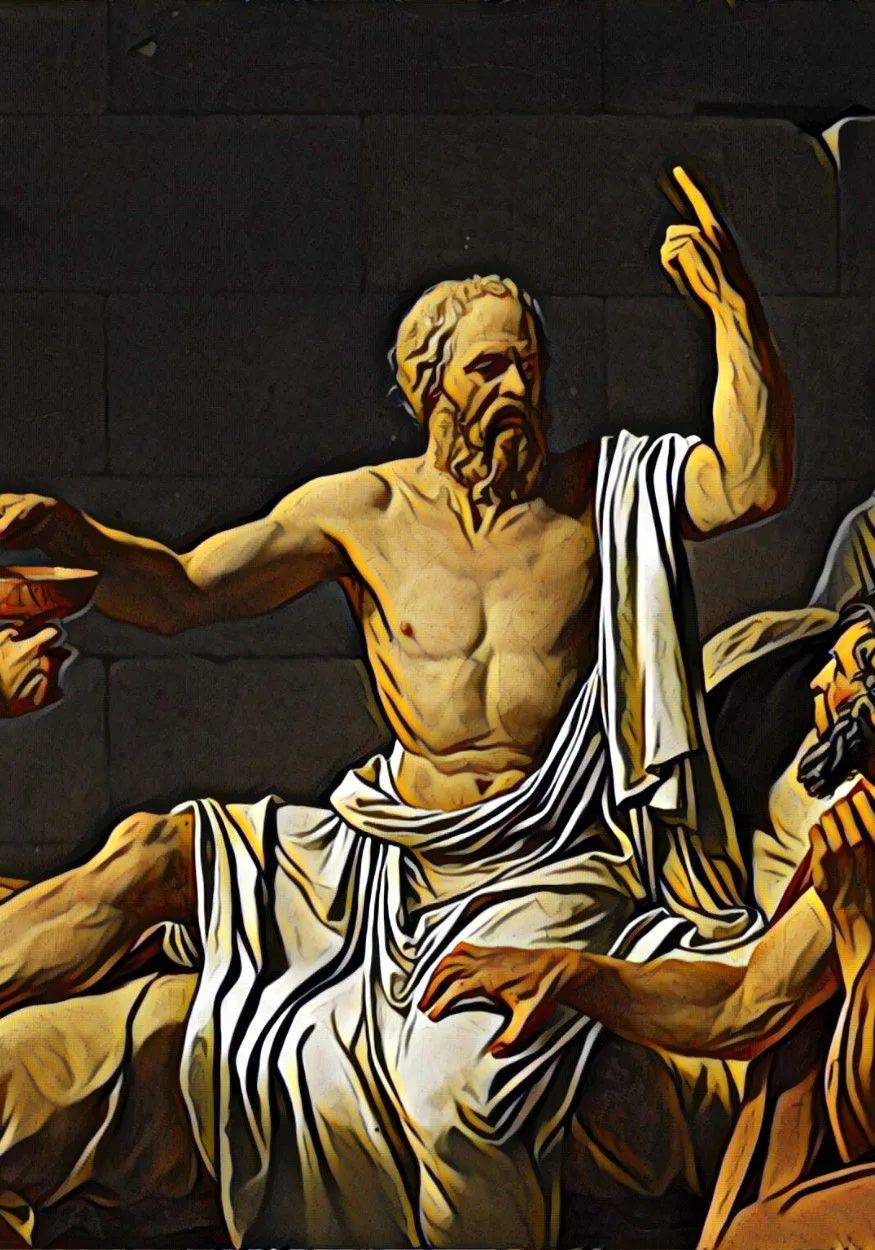 Photo: Socrates, via i.pinimg.com
Cause and effect? Maybe. The theoric fund gave ordinary Athenians enough economic security to participate in civic life, attend the theater, and engage with the cultural innovations happening around them. When you're not worried about where your next meal is coming from, you have time for philosophy.
Modern UBI advocates make exactly this argument: give people basic economic security, and they'll have the freedom to pursue education, start businesses, create art, or just live more fulfilling lives.
The Athenian experience suggests they might be right. For a while.
When the Money Ran Out
The problem with funding UBI through natural resource windfalls is that windfalls don't last forever. By the 4th century BC, the silver mines were producing less, and Athens was facing new military pressures from Sparta and other rivals.
Suddenly, the government had a choice: cut the theoric fund payments, or find the money somewhere else.
They chose option two. And that's when things started going wrong.
To maintain the popular cash payments, Athens began diverting money from other government functions. Military spending got cut. Infrastructure maintenance was deferred. Public investment in everything from roads to ships declined.
The theoric fund, which had started as a way to distribute genuine surpluses, became a drain on the treasury that crowded out other essential government functions.
The Political Trap
Here's the part that should terrify any modern politician considering UBI: once Athenians got used to their regular cash payments, it became politically impossible to eliminate them.
Every politician who suggested cutting the theoric fund faced immediate backlash from voters who had come to depend on the money. Even when it was obvious that the payments were undermining Athens's military readiness and long-term fiscal health, no one wanted to be the politician who took away people's free money.
This created a vicious cycle. The theoric fund became increasingly expensive to maintain, which required cutting other government services, which made ordinary Athenians more dependent on their cash payments, which made the payments even more politically untouchable.
Does this sound familiar? It should. It's the exact same political dynamic that makes Social Security and Medicare so difficult to reform in modern America. Once people start receiving government benefits, those benefits become political third rails.
The Military Consequences
The most tragic part of the Athenian story is how the theoric fund ultimately undermined the very democracy it was supposed to support. As military spending declined, Athens became increasingly vulnerable to external threats.
When Philip II of Macedonia began expanding southward in the 350s BC, Athens struggled to respond effectively. The same citizens who had benefited from decades of theoric fund payments were reluctant to support the military spending necessary to defend their city.
The great orator Demosthenes repeatedly warned that Athens was trading its long-term security for short-term prosperity. He was right, but politically powerless. Voters preferred politicians who promised to maintain their cash payments over those who wanted to rebuild the military.
By 338 BC, when Philip defeated the Athenians at the Battle of Chaeronea, the age of Athenian independence was effectively over. The theoric fund had helped create a golden age, but it also helped end it.
What This Means for Modern UBI Debates
The Athenian experience doesn't prove that UBI is good or bad—it proves that the political challenges of implementing cash transfer programs are timeless.
Every argument being made about UBI today was made in ancient Athens. Supporters argued that cash payments would reduce poverty, increase civic participation, and give people the freedom to pursue their potential. Critics worried about fiscal sustainability, work incentives, and the political difficulty of ever scaling back the program.
Both sides were right, and both sides were wrong.
The theoric fund did help create conditions for Athens's golden age. It also contributed to the city's eventual decline. It reduced immediate economic hardship for many citizens. It also created long-term fiscal problems that proved politically impossible to solve.
The Uncomfortable Lesson
If there's one lesson from Athens's UBI experiment, it's this: the biggest challenge isn't economic—it's political. Designing a cash transfer program that works in theory is relatively straightforward. Designing one that remains politically sustainable over decades is much harder.
The Athenians discovered what every modern democracy has learned: once you start giving people free money, stopping becomes incredibly difficult, regardless of changing economic circumstances.
That doesn't mean UBI is doomed to fail. Alaska's Permanent Fund Dividend has survived for forty years, and other experiments are showing promising results. But it does mean that anyone serious about implementing UBI needs to learn from Athens's mistakes.
Because human political psychology hasn't changed in 2,500 years. We still want free money when times are good, and we still resist giving it up when times get tough. The Athenians just got there first.